Iceland is a land of fire and ice, where volcanoes rumble beneath glaciers and the ground steams with geothermal energy. It is also home to one of the highest concentrations of geysers on Earth. While geysers exist in other volcanic regions like Yellowstone National Park in the United States, New Zealand, Russia, and Chile, Iceland holds a special place in geological history – it even gave the phenomenon its name. But what makes this North Atlantic island so uniquely suited for producing these spectacular natural fountains?
The Perfect Geological Setting
The abundance of geysers in Iceland is a direct result of the island’s unique position on the Mid-Atlantic Ridge, where the Eurasian and North American tectonic plates are slowly pulling apart. This divergent plate boundary creates intense volcanic activity, a network of fissures, and an unusually high geothermal gradient. In simple terms, hot magma lies very close to the Earth’s surface.
Most of Iceland’s geysers are distributed along a zone stretching from the southwest to the northeast, precisely following the boundary between these two tectonic plates. This location provides the three essential ingredients required for geyser formation:
- Heat: Proximity to magma chambers that heat the surrounding rock to extremely high temperatures.
- Water: Abundant surface water from rainfall, snowmelt, and glacial runoff that can seep deep underground.
- A unique plumbing system: A network of fractures, fissures, and porous spaces that create natural reservoirs and constrictions, allowing pressure to build up.
The Icelandic “Gusher”: Geysir
Perhaps the most significant reason for Iceland’s fame in this area is the original Geysir (pronounced “gay-seer”), located in the Haukadalur Valley. The English word “geyser” is derived from the Icelandic verb gjósa, meaning “to erupt” or “to gush forth.”
According to the U.S. National Park Service, accounts of a geyser at Haukadalur date back to 1294. At its most active, Geysir (also known as the Great Geysir) was incredibly powerful. Historical records from 1630 describe eruptions so violent that “the floor of the valley trembled.” Major eruptions could send boiling water soaring up to 61 meters (200 feet) into the air.
However, like many geysers worldwide, Geysir is temperamental. It has repeatedly gone dormant for years or even decades, only to be dramatically reawakened by earthquakes that shift the underground plumbing. The last major reawakening occurred after an earthquake in June 2000, demonstrating the direct link between Iceland’s seismic and geothermal activity.
Not Just One: A Field of Geysers
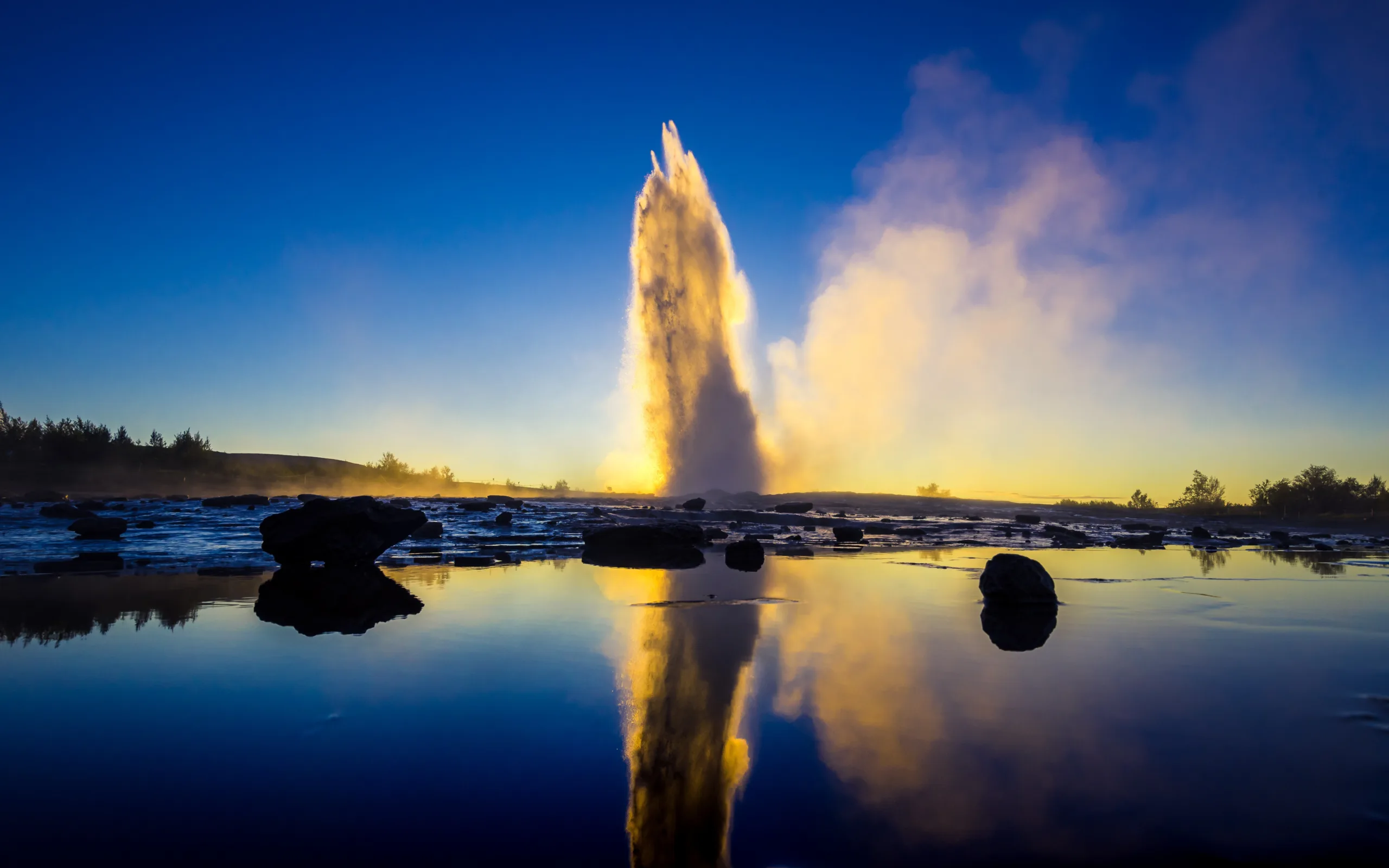
While the Great Geysir gets the glory, it is not alone. Iceland is home to approximately 20-29 active geysers, as well as numerous dormant or extinct ones. The most popular active geyser in the country is Strokkur (Icelandic for “churn”), which lies right next to Geysir.
Unlike its unpredictable neighbor, Strokkur erupts with clockwork regularity every 5–8 minutes, shooting water to a height of 20 to 30 meters (about 65–100 feet). This reliability makes it a major tourist attraction and one of the most famous geysers in the world. The Haukadalur Valley alone contains around a dozen other hot springs, mud pots, and smaller geysers, creating a complete geothermal spectacle.
Why So Many Geysers?
The sources note that geyser fields are rare globally. Iceland’s abundance is due to a combination of high volcanic activity and, interestingly, the shorter lifespan of its geysers. Unlike Yellowstone’s massive, stable geyser basins, Icelandic geysers are comparatively short-lived.
Many geysers in Iceland are reactivated or newly created after earthquakes, only to become dormant or extinct after a few years or decades. This constant cycle of creation and dormancy, driven by ongoing tectonic activity, means that at any given time, there are “so many” (around two to three dozen) active geysers scattered across at least a dozen different areas, such as Hveravellir.
A Fragile Phenomenon
It is also worth noting what makes geysers rare in the first place. Geysers require precise conditions. The underground plumbing must have constrictions (narrow channels) that allow pressure to build up. Without these constrictions, the water simply circulates back to the surface as a hot spring or a fumarole (steam vent).
Iceland’s young, fractured volcanic rock is ideal for creating these temporary, complex plumbing systems. However, the same forces that create them can also destroy them. Earthquakes can shift rock formations, and minerals dissolved in the hot water (primarily silica) can deposit geyserite, slowly sealing off the underground channels.
Conclusion
There are so many geysers in Iceland because the island is a natural laboratory for geothermal and tectonic processes. It sits atop a divergent plate boundary with high volcanic heat, abundant water, and constantly shifting ground that creates the perfect, albeit temporary, underground plumbing for these fountains. Furthermore, the Great Geysir itself is the namesake for all such phenomena worldwide. While Geysir may sleep, its neighbor Strokkur continues to churn every few minutes, reminding visitors of the powerful, restless energy that makes Iceland one of the world’s premier geyser fields.
Sources