For a country located at the physical heart of Europe, Poland’s history is a breathtaking epic of resilience, cultural brilliance, and a persistent will to exist. Its borders have shifted, disappeared, and reappeared, but the Polish spirit has remained a constant.
To understand Poland today, one must look at the key eras that shaped this nation.
1. The Birth of a Kingdom (966 – 1385)
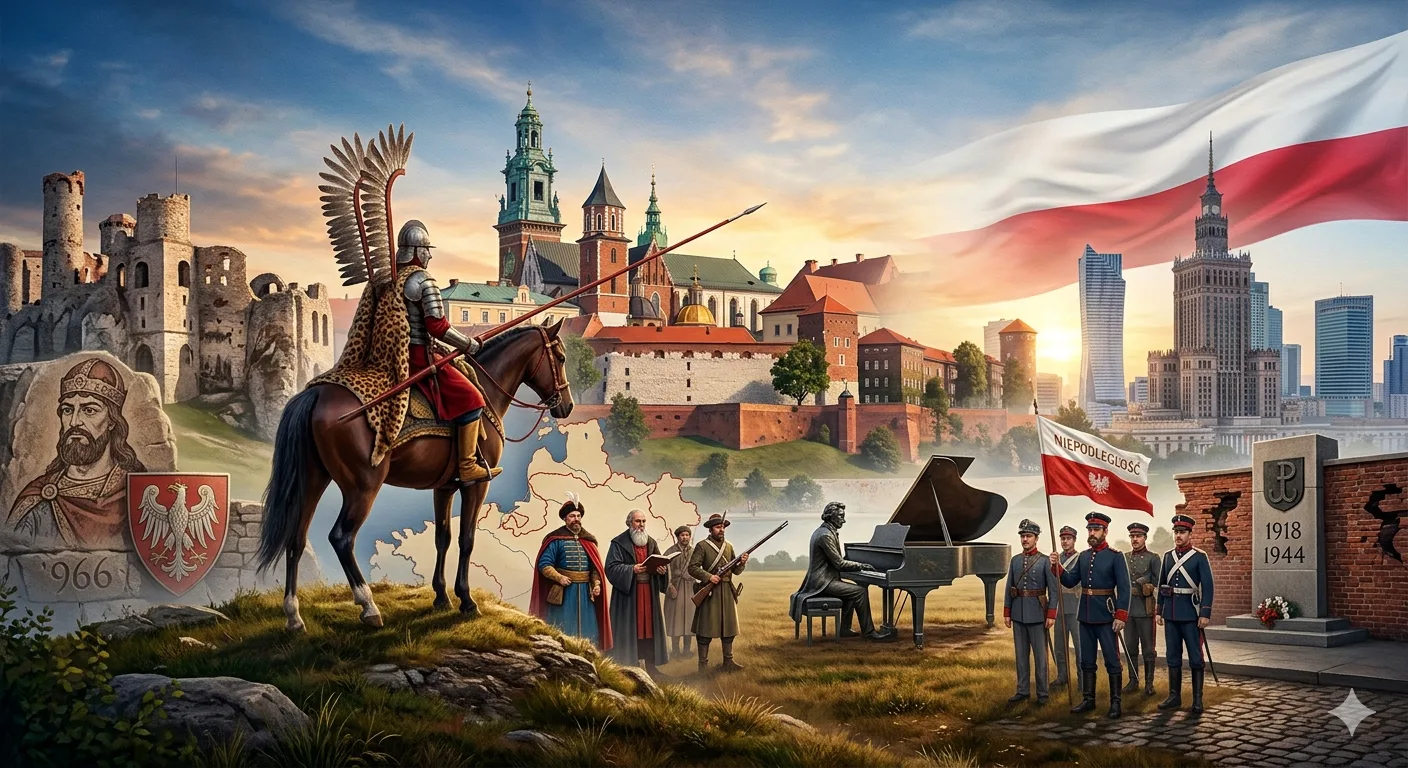
Poland’s official history begins in 966 AD, when the pagan ruler Mieszko I converted to Christianity. This “Baptism of Poland” integrated the Western Slavic tribes into the Latin civilization of Europe.
Under the Piast Dynasty, Poland grew into a stable kingdom. The era’s peak came with Casimir the Great, of whom it was said: “He found a Poland made of wood and left it made of stone.” He founded the Jagiellonian University in Kraków (1364), one of the oldest in the world.
2. The Golden Age: The Polish-Lithuanian Commonwealth (1385 – 1795)
Through a royal marriage, Poland united with the Grand Duchy of Lithuania, creating one of the largest and most powerful entities in Renaissance Europe.
- The Noble Democracy: While other European powers were moving toward absolute monarchy, the Commonwealth developed a unique system where the nobility elected the King and held significant power.
- Religious Tolerance: During the Reformation, while the rest of Europe was torn by religious wars, the Commonwealth was known as a “haven for heretics.”
- Military Might: This was the era of the Winged Hussars, the elite cavalry that famously saved Vienna from the Ottoman Empire in 1683.
3. The 123 Years of Absence (1795 – 1918)
Internal political decay and the rising power of neighbors led to the Partitions of Poland. In 1795, Poland was wiped off the map, divided between Russia, Prussia, and Austria.
Despite having no country, the Polish nation survived through its culture. This was the time of great Romantics like the composer Frédéric Chopin and the poet Adam Mickiewicz. Numerous uprisings (1830, 1863) were brutally suppressed, but they kept the dream of independence alive.
4. Independence and World War II (1918 – 1945)
In 1918, following the collapse of the partitioning empires in WWI, Poland regained its independence. This “Second Republic” lasted only 21 years before the catastrophe of World War II began with the Nazi German and Soviet invasions in September 1939.
Poland suffered more than perhaps any other nation during the war. It was the primary site of the Holocaust, and its capital, Warsaw, was systematically razed to the ground after the 1944 Warsaw Uprising.
5. The Iron Curtain and the Fall of Communism (1945 – 1989)
After the war, Poland fell under the Soviet sphere of influence. For over 40 years, it was a satellite state of the USSR. However, the Polish people never fully accepted the communist system.
- 1978: The election of Karol Wojtyła as Pope John Paul II gave the nation immense moral hope.
- 1980: The Solidarity (Solidarność) movement, led by a shipyard electrician named Lech Wałęsa, became the first independent trade union in the Soviet bloc.
- 1989: Peaceful “Round Table” negotiations led to the first partially free elections, triggering a domino effect that brought down the Berlin Wall and ended the Cold War.
6. Modern Poland (1989 – Present)
Since 1989, Poland has undergone a remarkable transformation. It joined NATO in 1999 and the European Union in 2004. Today, it is one of the fastest-growing economies in Europe, successfully bridging its tragic history with a dynamic, modern future.
Key Historical Figures to Know
| Name | Role | Why they matter |
| Nicolaus Copernicus | Astronomer | Proved the Earth revolves around the Sun. |
| Marie Curie | Scientist | First person to win two Nobel Prizes (Physics and Chemistry). |
| Frédéric Chopin | Composer | Transformed Polish folk music into global classical masterpieces. |
| Lech Wałęsa | Activist/President | Led the movement that ended Communism in Poland. |