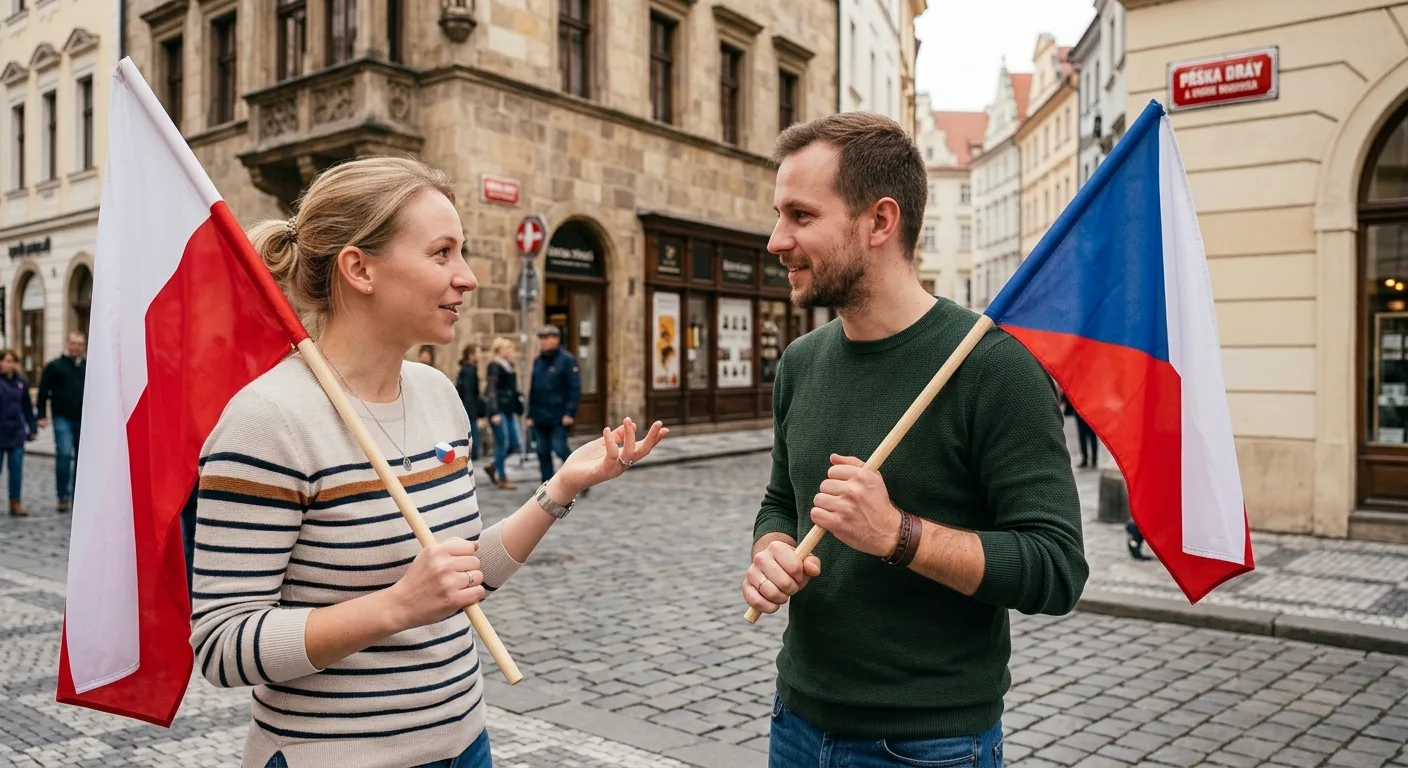
At first glance, Polish and Czech might seem like two sides of the same Slavic coin. Both are spoken in neighboring Central European countries, both use the Latin alphabet, and both sound similarly melodic to an outsider’s ear. However, while they share a common ancestry, their relationship is more like that of cousins than twins. They are genetically close, but typologically different . This means they have evolved from the same root but have developed distinct systems of pronunciation, grammar, and vocabulary that can make communication both surprisingly easy and unexpectedly hilarious.
A Shared Ancestry of Polish and Czech: The West Slavic Branch
Both Polish and Czech are members of the West Slavic subgroup of the larger Indo-European language family . This means they are descendants of a common Proto-Slavic language. However, they belong to two different branches within the West Slavic group. Polish is a Lechitic language, along with Kashubian and Silesian (spoken by small groups of people in Poland), while Czech is a Czech-Slovak language, along with Slovak . This split contributed to their divergent paths.
Historically, the relationship was even more intertwined. After the Christianization of Poland, the early Polish literary language was heavily influenced by Czech, with many Latin and German loanwords entering Polish in their Czech form. This influence lasted until the 16th century, the “Golden Age” of Polish literature . Since then, both languages have evolved independently, leading to the linguistic differences we see today.
Can Poles and Czech Understand Each Other?
The short answer is: partially. This phenomenon is known as “semicommunication” where speakers of closely related languages can use their mother tongues to communicate with each other.
Research(1) shows that mutual intelligibility is asymmetric . This means that Czechs generally understand Polish better than Poles understand Czech. Studies have found that Czech speakers consistently score higher on tests of understanding written and spoken Polish. This is likely due to the fact that Czech has a more regular and phonetically transparent spelling system, making it easier for Czechs to interpret the more complex, consonant-heavy spelling of Polish .
In practice, a Pole and a Czech can often hold a conversation, but it requires effort. They have to speak slowly, use simple sentences, and rely heavily on context. The conversation is a constant negotiation of meaning, which they achieve through communication strategies like asking for clarification and guessing from context . When the topic shifts to more specialized or complex subjects, the intelligibility drops significantly.
Polish and Czech Vocabularies: Similarities and “False Friends”
The core of the confusion – and the fun – lies in the vocabulary. While there are many words that are similar and easy to guess, there are just as many that are completely different or, even worse, sound almost identical but mean something entirely different. These are known as “false friends” .
Similar Words in Polish and Czech
Because they share a common Slavic root, many basic words are similar or identical:
| Polish | Czech | Meaning |
|---|---|---|
| matka | matka | mother |
| ręka | ruka | hand/arm |
| człowiek | člověk | human/person |
| piwo | pivo | beer |
| woda | voda | water |
False Friends (Different Meaning, Similar Sound)
This is where the trouble begins. A simple conversation can quickly become an awkward or comical misunderstanding. Here is a table of some of the most famous and dangerous examples:
As you can see, asking for a “fresh roll” in Poland by saying czerstwy chleb will get you a stale one. A Czech asking for a toilet (záchod) might be met with a confused look from a Pole if they hear the word zachód.
In conclusion, Polish and Czech are similar enough for their speakers to recognize they are from the same family, but different enough to make a conversation a constant adventure. They are a fascinating case of linguistic proximity, full of shared history, significant divergence, and a minefield of false friends.
1) The Measurement of Mutual Intelligibility between West-Slavic Languages




One Comment
For Polish people it is easier to understand slovak than czech language although they are similar.